Showing posts with label butterfly research and education. Show all posts

Saturday, July 23, 2016

“Sometimes I wonder whether the world is being run by smart people who are putting us on or by imbeciles who really mean it.”
~ Laurence J. Peter,
The Peter Principle


Eight new chrysalides, of which four eclosed and were released Friday. Released sixteen so far this season.

The Xerces Society has published the "State of the Monarch Butterfly Overwintering Sites in California" report recently, which you can access here:
 

The report shows a sharp two-decade decline in the number of monarchs which overwinter along the California coast and prioritizes the top 50 overwintering sites most in need of conservation and management attention. State of the Monarch Butterfly Overwintering Sites in California provides an analysis of western monarch population trends. A comparison of the average number of butterflies overwintering in California during the periods 1997–2001 and 2010–2014 shows a decline of 74% since the late 1990s, a figure that is comparable to declines documented at monarch overwintering sites in Mexico.

For those that have a penchant for Monarch butterflies, this report is a must read and worthy of keeping for future reference.

Let's not forget the potential downsides of  planting year-round milkweeds in our gardens. If possible, stick with native milkweeds, preferably ones native to your area. If you do grow perennial milkweeds such as Asclepias curassavica and wish to keep growing it, it's highly recommended to cut them way back each fall and winter to minimize unnatural overwintering of migratory Monarchs:

Another Damning Research Paper...

For some more exciting municipal government news, the City of Oakland, California has stepped up to the plate in support of our native butterflies and other pollinators through their system of city parks, via one of their employees, Park Supervisor Tora Rocha.


-https://www.gardentribe.com/
 Victoria 'Tora' Rocha. Park Supervisor, City of Oakland, California


-Google


Tora has been instrumental in introducing and cultivating pollinator plants in her parks with blessings from city management. Not only that, but the City of Oakland even allows volunteer citizen groups to help out in the parks. Not a new concept, but a very foreign notion to some municipalities; at least to the City of Laguna Beach, apparently.


-http://www.pacifichorticulture.org
 Garden volunteers at Oakland's Gardens at Lake Merritt.

For those that know me and have been following this blog for some time, I have been at odds with the CLB (City of Laguna Beach) management regarding planting for butterflies and the use of citizen gardening volunteers, ever since I was employed as a Parks Gardener there. Hopefully, citizen awareness and a grass roots movement may sway city fathers to reconsider their aversion to the concept.

For more information on Tora Rocha:


Perhaps those LB warriors with like interests could contact Tora for some mentoring on how to achieve similar goals within their own borders.

Will someone please help take over this abandoned Laguna Beach butterfly garden? The current city gardener is doing his best maintaining and improving it, given the allotted time, resources, and management indifference he must contend with:

http://lagunadirt.com/2012/04/a-butterfly-garden-with-a-mission.html


Saturday, December 19, 2015


"Weather means more when you have a garden. There's nothing like listening to a shower and thinking how it is soaking in around your green beans."
~Marcelene Cox


The link below provides a great map of Monarch butterfly overwintering sites along the west coast. Laguna Beach boasts three sites listed if one includes Crystal Cove, although two of them show zero recent counts. One site listed is Smithcliffs, which ceased to exist when the bluffs there were converted into a residential area. Last count at Crystal Cove was taken in 1993. No one has been monitoring it since then.

Irvine Bowl shows 5 counted in 2008. From my previous casual counts at the Bowl for a period of a decade, + or - a year or three,  the average numbers were 5 to 8 (+ or -) at any given time. If I had to guess, there were probably around a dozen individuals that overwintered in the Bowl on any given year I counted. One can sign up online to be a citizen scientist to monitor sites listed on the map. Contact information is available online. The Irvine Bowl would be an easily accessible site for anyone living in LB interested in such an endeavor.

Laguna Beach, with its diverse array of micro climates, is a prime candidate for potential overwintering site analysis and possible incorporation of overwintering sites within the City through judicious planting, both public and private. How hard it would be to research and implement such a scheme would of course, need research. A concerted effort between interested citizens and an enthusiastic municipality would certainly go a long way in realizing such an endeavor.


-Google


Interesting and informative O.C. Register article on the Western race of Monarch butterflies, with many people pitching in to help them by planting way stations in gardens:


Sunday, June 21, 2015


"It is good to be alone in a garden at dawn or dark so that all its shy presences may haunt you and possess you in a reverie of suspended thought."
~James Douglas


The Environmental Nature Center in Newport Beach, Calif. currently has their Butterfly House open to the public.


-ENC - Environmental Nature Center. Newport Beach, Calif.


Dovetailing into the previous post about I.P.M., here is a disturbing article regarding the effects of neonicotinoids in our own gardens and how tenacious and pervasive these chemicals can be:


Pretty scary stuff: a much greater residual effect versus its granddaddy, nicotine sulfate. What is surprising and particularly disturbing is the almost ubiquitous presence of "neonics" amongst the plant offerings occupying our nursery rows and shelves, even present in the veggie paks we bring home to plant in our own gardens. Trying to avoid these chemicals applied on our foods out in the growing fields and during processing, they migrate home with plants we purchase in order to sidestep pesticides.

There's a dearth of butterflies at the moment here in the Container Butterfly Garden. Not sure why, as now is the time when butterflies of all sorts begin to come on strong as summer approaches. One female Monarch is flitting about ovipositing eggs, and I've seen a lone Gulf Fritillary visiting my Passion Fruit vine. A few Monarch caterpillars have been spotted, not to mention the multitude of Oleander aphids on the milkweed plants this year. I attribute the aphis explosion to the warmer than normal winter temps we experienced. Colder temps will kill off many of the aphid pests, but such was not the case last winter.

Regarding Oleander Aphids, I'm willing to share if anyone wants any. There were lots of ladybugs around happily feasting on them, but they too have disappeared at the moment. Now may be the time to spot-spray those tiny yellow beasties with insecticidal soap before the Monarchs return in full force and start laying eggs. The aphis populations are dramatically decreasing though now, as I suspect predator populations have increased to the point where their influence is noticeable. Upon close examination, some aphid carcasses are mere shells, most likely the aftereffects of wasp predation. Others are dried up, shriveled specks, which I suspect are the work of sucking insects. So yes, I.P.M. works, if one is willing to forgo garden perfection and allow nature to do what nature does, as it has done for generations past.


Saturday, May 9, 2015


"When I go into the garden with a spade, and dig a bed, I feel such an exhilaration and health that I discover that I have been defrauding myself all this time in letting others do for me what I should have done with my own hands."
~Ralph Waldo Emerson


YAY! We've been blessed with a bit more rain so unseasonably late for this amount of the stuff! Our flora and fauna will much appreciate it too.

Here's some new garden tech that you can manipulate with your smart phone, both iOS and Android:

"Blossom hands-on: Control your intelligent sprinkler system with your smartphone. 
Summary: As water supplies are reduced and people look to save money, internet-connected devices like the Blossom can pay for themselves in no time. Matthew installed a new controller system in about 10 minutes."
 

Good news! An announcement about the new Monarch Program site in Bonsall, California. Included are some photos I took on a visit to the now defunct Encinitas location a few years back:

The Monarch Program that was located in Encinitas since its opening in 1990, closed down in 2013 after losing their lease. During the interim, it has been looking for a new home where it can once again resume serious Monarch butterfly research, and to offer exhibits and a butterfly vivarium for the public. Many San Diego North County school children went on field trips to the center, learning about and experiencing the delight and wonder of butterflies. They recently opened a temporary facility in Fallbrook, California until they find a permanent home.


These photos were taken in 2010 when the Monarch Program was still in Encinitas, California. The vivarium these butterflies resided in housed at least half a dozen species of local butterflies. They went gaga over the Pentas growing within the enclosure and absolutely loved the sugary watermelon bits offered them. A large plate full of watermelon, cantaloupe, and orange slices placed in the middle of the vivarium became the favorite gathering spot for these winged beauties.


© Andrew Kliss Photography

Monarch butterfly feeding on Pentas.


© Andrew Kliss Photography

Little boy holding watermelon slice, visited by Monarchs.


© Andrew Kliss Photography

Sipping watermelon juice off fingers.


Verbena bonariensis was a very successful nectar plant in the Alta Laguna Park Butterfly Garden. Not only did it attract butterflies, especially Monarchs and swallowtails, an added bonus was it attracted seed eating birds too, such as finches when I left seed heads on the plants.

V. bonariensis, or more commonly known as Purpletop Vervain (and a myriad of other names) is a tall, rather informal-looking plant that some would describe as rather coarse or rough. I like the looks of it. It fits right into more provincial style gardens such as English cottage, and informal SoCal styles.


-Google (caption mine)


Verbena bonariensis. Purpletop Vervain; Clustertop Vervain; Argentinian Vervain; Pretty Verbena; Tall vervain; Upright Verbena; yada-yada...


-Google

V. bonariensis flower head, or inflorescence, comprised of tiny florets.

A fairly prolific seed maker, you'll soon have plenty of seedlings up and running to plant in other parts of your garden and to give to appreciative friends. Don't worry about it taking over your garden though, as it pulls out very easily, and there aren't that many who volunteer to pop up and grace your garden. If one is afraid of being overrun with a myriad of young volunteers, cutting off the seed heads before they ripen will take care of that.

Because of its height, it's useful as a background plant. Serving double duty, V. bonariensis can be effective towards the front of a garden or in the middle. Being so light and airy, it doesn't obstruct the view of any plants or garden features behind it; perfect for adding a bit of drama.

Care and Feeding

An easy care plant, all it needs is sun and a tiny bit of room to grow in. Appreciative of water, once established, it can do with minimal irrigation. One caveat: those growing in the Container Butterfly Garden do show stress pretty fast if the potting soil is allowed to thoroughly dry out. In the ground, I didn't have that problem.

If your soil is fertile, a twice per year feeding should be all that's needed. Those with poor soils or grown in pots, a monthly feeding would be welcome.

V. bonariensis can be considered a short lived perennial. Allowing a couple of seed heads to ripen will give you plenty of seedlings to replace old and tired, or dead plants. Don't let the seedlings get too tall before transplanting. They produce somewhat of a longish taproot that when disturbed could put the kibosh on revival. It can be done, but you'll need to dig up a hefty amount of soil with it in order to preserve the roots.

A simple method of propagation is to cut off some ripened seed heads while holding them upright, and then turning them upside down and shaking the seed heads on a new spot in the garden or in a pot of fresh potting soil.

Don't overlook this plant as a candidate for your butterfly garden. IMHO, it's a highly desirable pick for its ability to attract both butterflies and seed eating birds, is pretty much pest free, and adds an air of... well, "airiness" to a garden. Relatively common in most major nurseries. There is a dwarf version of V. bonariensis named 'Lollipop', but I have no idea as to its butterfly magnetism. 

Buying a pack of seeds and starting your own is a good alternative if you don't know a person who is willing to share a plant or two with you.


Friday, June 20, 2014


 “The caterpillar does all the work, but the butterfly gets all the publicity.”
-George Carlin


I need to reiterate:
most - if not all - of the butterfly, caterpillar, and chrysalid photos in this blog have been downloaded from web searches. I've received several comments lately about their high quality and the assumption that I took them.

In order to allay any confusion or misconceptions regarding photo authorship, this blog will begin to give credit either to the blog author or Google, which this site uses extensively. I don't have the amount of caterpillars, chrysalids, and butterflies at my disposal, nor the patience to chase down and try to produce quality butterfly photos. I have a cat; trying to corral him at times for either beneficial or seemingly ulterior motives is enough of a patience tester for me as it is.


Butterfly Farms in Vista, California, held an open house of their facilities June 14. They offer butterfly-specific plants for sale on top of regular landscape fare, and is home to the largest butterfly vivarium in California according to their Facebook page, .

Butterfly Farms has recently opened their doors. As such, it is in the process of growing, expanding, and maturing. The visit to the vivarium and butterfly plant nursery was a pleasant way to spend the later half of a Saturday morning amongst butterflies chrysalids, caterpillars, along with some of their favorite plants.


© Andrew Kliss


© Andrew Kliss

This netted building houses plants on sale specifically for butterflies.


© Andrew Kliss

Butterfly plants for sale.


© Andrew Kliss
Butterfly vivarium.


© Andrew Kliss

Once inside the vivarium, one is greeted by a landscape dedicated to supporting butterflies stocked with both host and nectar plants. The watermelon is used as an enticement to lure butterflies and makes for a good nectar substitute when low on flowers. Just about any fruit that contains sugars will work, even oranges. Cut up fruit in a dish and placed in the garden will keep butterflies coming to visit. Change periodically when fruit begins to dry out. Watch out for those pesky Argentine ants, as once they find it, they'll be all over it like flies on feces.


© Andrew Kliss


© Andrew Kliss


This is Micaela, the daughter of one of the owners with an Anise Swallowtail perched upon her forehead. She is the spokesperson, greeter, and unofficial mascot of Butterfly Farms.


© Andrew Kliss
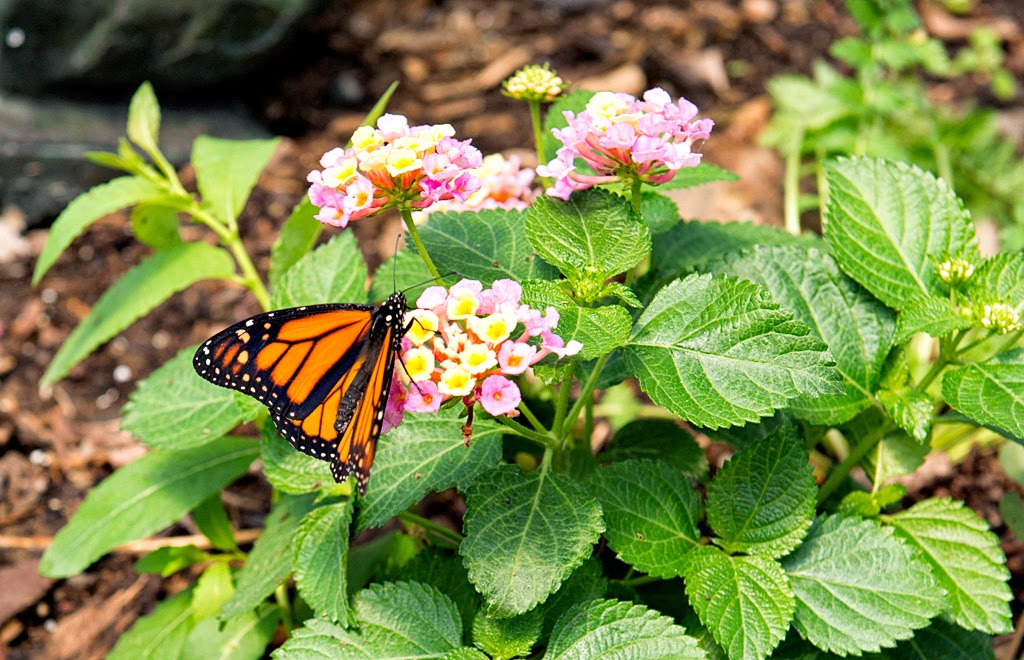
Monarch feeding on lantana.


Male Monarch feeding on Tropical Milkweed. Milkweeds serve a twofold purpose: nectar and host plants. Two gender identifying characteristics are the small black dots on each lower wing with males, and the absence of the dots, plus thicker black veins on wings with females.


© Andrew Kliss

Various instars of Monarch caterpillars chomping away on Tropical Milkweed. Notice the yellowish orange oleander aphids infesting the plant also, which was touched upon in the June 6th blog post.


© Andrew Kliss


© Andrew Kliss
Anise Swallowtail sipping watermelon juice.


© Andrew Kliss

There were several Anise Swallowtail chrysalids on display in the vivarium that exhibited several color morphs, dependent on what color their surroundings are. Above is one in green phase when what it attached itself to was still green. Below is a brown chrysalid blending in with its surroundings. This particular sad looking plant was donated to the vivarium for showcasing the various color forms. Unfortunately, transplant shock got the better of it.


© Andrew Kliss


© Andrew Kliss
Cloudless Sulfur caterpillar feeding on cassia spp.


© Andrew Kliss

The converted clothes hampers above make for great rearing pens. I've been lax with the butterfly web site and have not updated the type of laundry hamper I now use. I really like the Whitmor collapsible laundry hamper for its convenient size and zippered lid.

Is it worth one's time to go out of your way to visit the vivarium? No, not right now at least. If one lives close to Butterfly Farms, the trip is worth the short drive. It is too new and not mature enough to warrant a special trip right now. Next year at this time, the vivarium should be established enough to make a trip worthwhile.

The nursery is worth coming to, as it stocks a varied and large selection of nectar and host plants, with an emphasis on milkweeds. It is a nonprofit; plant sale proceeds go to operations costs, hosting school field trips, and advancing butterfly research.


Friday, June 6, 2014


“What the caterpillar calls the end of the world, the Master calls a butterfly.”
- Richard Bach


Now that butterfly season is ramping up, this post is longer than most, covering several different topics. 

Latest Container Garden News:
Found seven new Monarch cats this week. Looking for various swallowtail cat species on my fennel, dill, Queen Anne's lace, angelica, and common rue; all members of the carrot family, or Apiaceae, - except for common rue, which is a member of the citrus family - on which a few members of the swallowtail family host on. Haven't found any yet, but I did see an unidentified swallowtail cruising past the front of the house last week. Also spotted a Giant Swallowtail flitting about the neighbor's dwarf orange tree. Can only guess it was a female looking to oviposit some of her eggs.

The plants mentioned above make wonderful nectar sources on top of being hosts to several swallowtail species here in So Cal. I haven't seen any real nectar gathering on common rue, but that may be due to not seeing this type of activity because of timing: being at the right spot at the right time.

  • Fennel, dill, and Queen Anne's lace host the Anise Swallowtail and Black Swallowtail.
  • Queen Anne's lace also hosts the Giant Swallowtail and possibly the Black Swallowtail.
  • Angelica hosts... I'm not sure yet, as I've only started growing it this year. Makes an excellent nectar plant. Will update.
  • Rue hosts the Giant Swallowtail and Black Swallowtail.
Carrot cousins make for strong butterfly nectar magnets and are necessary host plants for swallowtails. Other members of the carrot family you would be familiar with are caraway, coriander, cumin, lovage, and parsley. The container garden is host to Angelica stricta "Purpurea", an exquisite beauty of a plant. Well worth looking into if one has the inclination to plant this biennial.


Many people plant only milkweed to attract Monarch butterflies, but swallowtails are beautiful guests to gardens too. A few representatives of the carrot family would go a long way in diversifying a butterfly garden, plus they are general nectar plants that Monarchs and others likewise feed on.

Speaking of milkweed:
'tis the season for oleander aphids to start making their appearance on your milkweed plants. These pesky little orange/yellow critters are more of a nuisance and eyesore than anything else, although, if one has severely distressed, sickened, or weak plants, they can succumb to large numbers of them. If you don't find any on your plants, consider yourself very lucky, as they are are pretty much endemic to most of the warmer sections of the U.S. and major portions of the world now.


Oleander aphids, Aphis nerii. The brownish aphids are carcasses of dead individuals parasitised by a tiny wasp.


It is an import that most likely originated in the Middle East where its namesake oleander is native of. It is very host specific, only feeding on a few garden plants here: oleander, milkweed, and hoya are pretty much it. Fear not, as they won't invade other plants one has in surrounding areas.


Tiny wasp parasitising an aphid by injecting a tiny egg in the aphid's body that will hatch to eat its host from the inside, out.


What's a person to do? Certainly not spraying for them, as that will kill any butterfly eggs or caterpillars that may be inhabiting your milkweed, and threaten any butterflies one wishes to attract. The best method is to practice mechanical and biological deterrents. If one has the inclination, one can squish the bastards little darlings between the thumb and forefinger. It's best to let nature take its course, allowing aphid predators to help put a dent on their populations.

The frequent and indiscriminate carpet bomb approach to pest management utilizing chemical sprays is an atrocity to nature. One effectively sterilizes an area, creating a vacuum. Nature abhors a vacuum. Pests return with a vengeance. When one has sterilized an area, one has also dispatched predators, but predators have a much slower rate of reproduction which allows pest populations to explode. So what does one do? ONE SPRAYS AGAIN. AND AGAIN. AND AGAIN...


 This ugly creature is the nymph of a cute ladybug. Ladybugs and their nymphs feast on aphids.


 Adult ladybug, or ladybird beetle as some call it, contentedly munching away on a soft bodied aphid.


 GACK! Ants!


In our warm weather area, we are cursed with another unwanted introduction, the Argentine ant. This little bugger invades gardens and homes and is quite pernicious. They actually round up and cultivate aphids for the honeydew they exude from their bodies, milking them as we do cows. Fierce protectors, they are able to fend off most aphid predator attacks. Bad juju. In order to allow aphid predators to do their thing, one must first eliminate Argentine ants from the garden - or at least on one's plants.

In summary, eliminate or severely curtail the use of pesticides, allowing a natural balance to rule your yard. I do believe in the localized and restricted use of pesticides when all other options have expired, but then allow nature to once again take over.


If you have an ant problem, target them and not the whole yard. There are baits one can place in the garden and house that ants will collect and take back to their colonies which in many instances kills off the colony, or at least severely limits their populations and destructive capabilities.

Milkweed in the container garden is beginning to attract oleander aphids. I do see ladybugs and I've done my share of squishing, and hopefully, predatory wasps have spied them too. Eventually, I'll throw in the towel, stare at the myriad maddening mass of orange/yellow aphid bodies, safe in the knowledge that my Monarch cats are well, my environment is healthy, and biodiversity rules this little corner of God's green earth.

Other News:
Two relatively close So Cal butterfly exhibits that are active at the moment are the ENC Native Butterfly House in Newport Beach, and the Rancho Santa Ana Botanic Garden Butterfly Pavilion, located in Claremont, California. The butterfly vivarium at Butterfly Farms in Vista is fully now open too.


Friday, May 16, 2014


"There is nothing in a caterpillar that tells you it's going to be a butterfly."
-R. Buckminster Fuller


YAY!!!


I found my first Monarch butterfly caterpillars on the milkweed growing in the container garden! Counted three Monday morning as I was watering the plants. Haven't seen many butterflies, but they are apparently making the rounds, as the three cats can attest to. Man, those little buggers grow fast!

Other News: 
  • Registered the garden with the Monarch Watch Waystation Program. Those of you who are familiar with the Alta Laguna Park Butterfly Garden may remember it was registered with them and received a green and white waystation sign. I should be receiving my sign soon.


Update: One cat got lost, one slinked away to turn into a chrysalis methinks, and the third is about half grown and growing bigger every day.


Friday, May 9, 2014


"I saw a poet chase a butterfly in a meadow.  He put his net on a bench where a boy sat reading a book.  It's a misfortune that it is usually the other way round."
-Karl Kraus


Starting to see several butterfly species passing through the container garden here. Saw several Gulf Fritillaries (many mistaken this species as a Monarch butterfly), with one visiting my Garlic Passion Fruit vine. Haven't noticed any cats on it, so it was either a male or non-fertile female. This particular passion fruit vine will be replaced with a more vigorous grower, Possum Purple. I hope to also get some delicious passion fruits from it! Alas, the Garlic Passion Fruit is not putting out enough leaves to feed a decent amount of GF cats, therefor the switch. I love its flowers, so I'll be putting it in its own pot and relegate it to the front porch where it will be allowed to cascade over the side.

Back in the  January 31st blog entry, there was a post written about Butterfly Farms of Vista, California being the new home of The Monarch Program. Well, things have changed a little bit since then. The center is located fifteen minutes away from where I live.

The Monarch Program has decided to pull out of Butterfly Farms and relocate somewhere else. There will still be a HUGE vivarium built, school field trips held, butterfly specific plants sold, and tours offered to the general public at Butterfly Farms.

I went back there fairly recently to check it out and get an update on their digs and to buy some milkweed for the Butterfly Container Garden. They want $10 for 1 gallon milkweed plants which is waaay too steep a price in my opinion, but it is a nonprofit, so the added cost is going to a good cause and not necessarily lining someone's pocket. They are also offering plants in 4 inch containers, but unfortunately I didn't get a price quote.


© Butterfly Farms
 Plant propagation greenhouse


It's going to be a very vibrant and aggressive center of butterfly related activity. Unfortunately, with The Monarch Program pulling out, the timeline for opening up the vivarium, hosting school field trips, and access to the general public has been set back by several months.


© Butterfly Farms
This vivarium will be the largest free flight butterfly house in Southern California once completed.


If they accomplish all they intend on doing, this endeavor will be a hub of west coast butterfly activity and influence. They are selling plants now, but the selection, size, and quantities are still a bit low. That should all change in May when plant stock should be up to snuff.

They also have a Butterfly Farms Facebook presence.